
No More Warehouse Fires: A Fire Detection and Suppression System
On January 6, 2022, a fire broke out at a logistics center construction site in Pyeongtaek, Gyeonggi Province. Three firefighters lost their lives battling the blaze, and the property damage was enormous. Following the Icheon HanExpress warehouse fire in April 2020 and the Icheon Coupang logistics center fire in June 2021, yet another large-scale fire has caused casualties and massive property damage,
and public concern and anxiety over warehouse fires are running high.
In response, the government has decided to conduct intensive inspections of construction sites and logistics warehouses nationwide. At construction sites, inspectors will focus on how fire hazards are stored and managed, whether fire watch personnel are deployed, safety management during welding and steel pipe cutting work, and the installation and upkeep of ventilation systems for hazardous gases in confined spaces. The Seoul Metropolitan Fire and Disaster Headquarters also announced emergency special fire inspections of every warehouse facility in Seoul, carried out through on-site visits to check the maintenance of firefighting systems and the performance of fire safety management duties. Meanwhile, the Ministry of Justice task force on serious safety accidents (TF) published a casebook analyzing 16 major safety accidents from the past five years. The casebook will be shared with the Ministry of Employment and Labor and other related agencies to discuss practical institutional improvements, and distributed to the Supreme Prosecutors’ Office and district offices as reference material for investigations.
Experts say the situation will not improve if responses end with one-off inspections and for-show administration after each accident.
They agree that institutional reform that fundamentally resolves the underlying structural problems is urgently needed
to build effective measures against recurrence. Momentum is gathering behind calls to pursue R&D on fire safety for logistics facilities and to establish sprinkler installation standards suited to warehouses, and attention is now focused on what measures will follow.
Warehouse Fire Trends and Characteristics
As COVID-19 made contactless online shopping part of everyday life, demand for fast delivery such as early-morning and same-day delivery surged, and warehouse functions expanded from simple storage to processing and cold storage.
As of 2021 there were 4,673 logistics warehouses nationwide, a number that grows every year
, with a particularly sharp increase in 2020. Investment in logistics centers reached roughly KRW 2.535 trillion in the fourth quarter of last year, the highest quarterly figure on record. The addition of new functions is changing the architectural profile of warehouses — larger facilities, new equipment, and greater power demand — and countermeasures for these changes are needed.
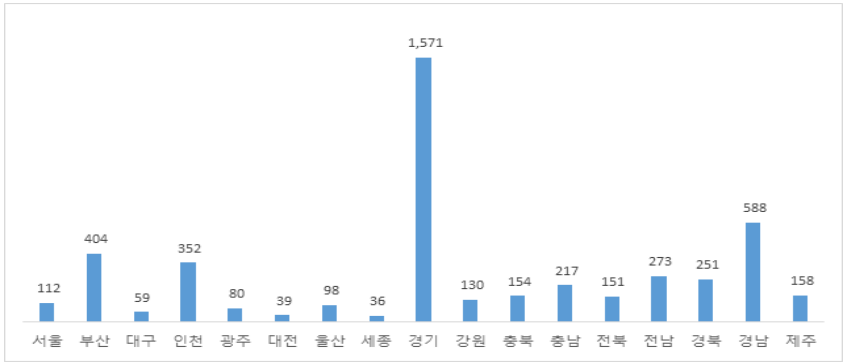
Registered logistics warehouse businesses by region / Source: National Logistics Information Center
Warehouse Fire Statistics
Over the past five years (2016~2020), a total of 7,227 warehouse fires occurred — an annual average of 1,445. These fires caused 258 casualties (55 deaths and 203 injuries). Among the causes, ‘carelessness’ was the most common at 45.7%, followed by ‘electrical factors’ at 27.6%. The Coupang warehouse fire is also presumed to have been caused by electrical factors.
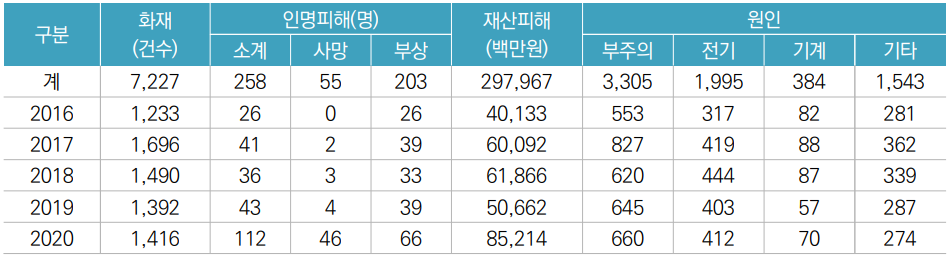
Warehouse fire damage and causes / Source: Warehouse Fire Safety Management Manual
In terms of frequency and property damage, an average of 1,445 warehouse fires occur every year; while the count has edged down since peaking in 2017, property damage has actually increased. Given the function and nature of warehouse spaces, these fires tend to cause far greater property damage than casualties. As for casualties, the warehouse-related fires that historically caused major loss of life occurred at sites under construction or renovation. But with the recent surge in large warehouses, concern is growing over the fire vulnerability of completed, operating facilities and the potential for large-scale damage when a fire breaks out. The death toll over the past five years — 0, 2, 3, 4, and then 46 — further underscores this trend.
Characteristics of Warehouse Fires
Because the fundamental purpose of a warehouse is to store goods, warehouses are typically built with high ceilings and wide floor areas to maximize space. With the recent growth in parcel volumes from early-morning delivery, expanded warehouse functions, and changing warehouse characteristics, both the risk of fire and the risk of casualties and property damage are rising sharply.
If initial suppression fails when a fire breaks out, the high fire load (Fire Load)19) from stored goods can lead to casualties and property damage and even the collapse of the building itself. Structural issues such as basement and windowless floors and relaxed fire compartment requirements make it hard to guarantee safe evacuation for occupants, and they also make firefighting operations extremely difficult.
As building forms become more diverse and complex and usage patterns keep changing,
ensuring fire safety requires the installation and maintenance of firefighting systems that encompass both space and function.
Thingplus Fire Detection and Suppression System
The Thingplus fire detection and suppression system
detects and extinguishes fires at the earliest stage with real-time monitoring and a smart automatic extinguisher that senses temperature changes on its own
. This
innovative automatic extinguisher needs no power: a smart capsule that releases extinguishing agent automatically in a fire uses its own temperature sensing to react the moment the preset temperature is reached
. When the capsule inside the stick reacts to heat and releases the agent, it smothers and cools the fire at the same time, suppressing it effectively.
The Thingplus fire detection and suppression system monitors changes in smoke concentration and temperatures above set thresholds
, specializing in catching the early signs of fire and extinguishing it at the initial stage. And in case the smart capsule fails to activate even when a fire is detected,
it also monitors agent leakage and the operating status of the extinguisher
, staying thoroughly prepared for every scenario.
A key strength of the Thingplus fire detection and suppression system is how easily it can be installed in fire blind spots
. It fits readily inside distribution panels and switchboards of any size and can be applied to a wide range of industrial equipment, including various power distribution panels. The compact smart capsule is ideal for small spaces such as switchboards, where early detection is difficult, and for places that are hard to reach by hand.
It is well suited to warehouses, to multi-use facilities such as exhibition halls and hospitals, and to traditional markets
.
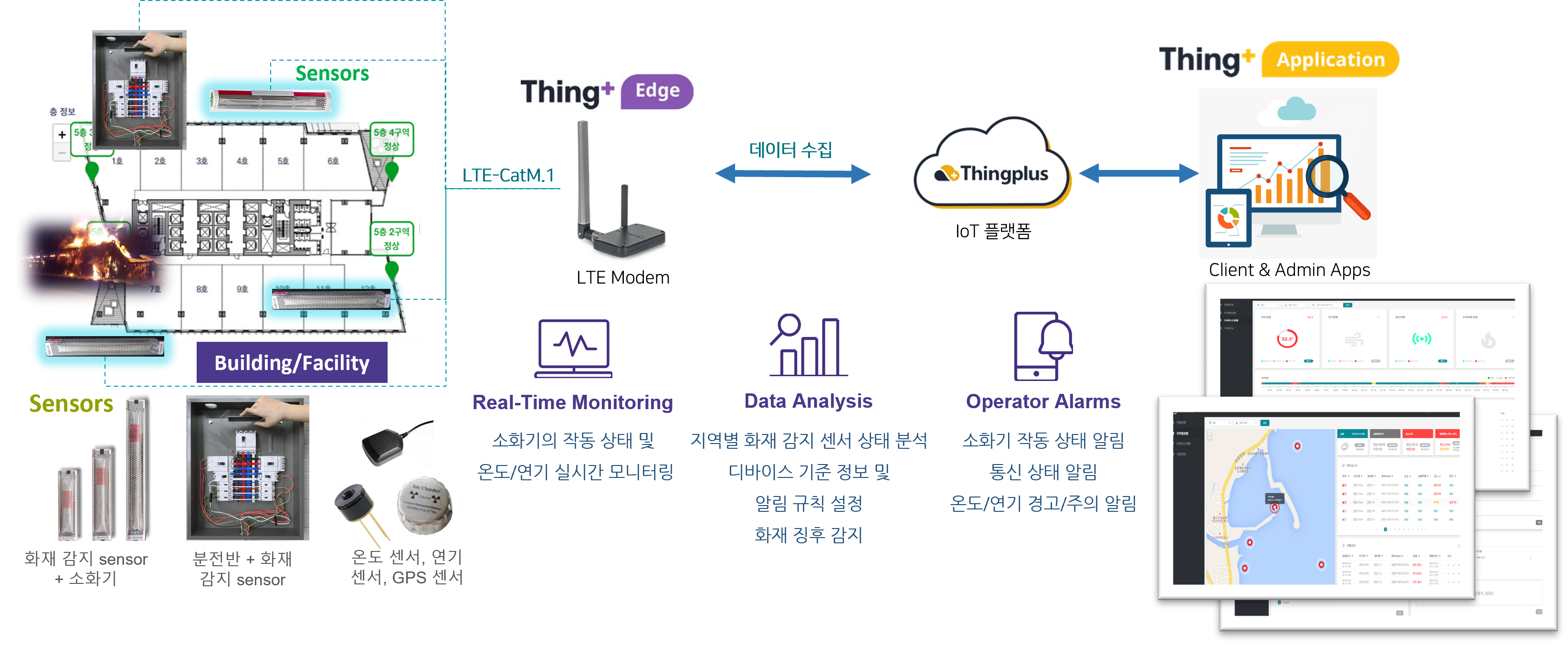
Key Features
Warehouses combine traits that make fire safety hard to secure — wide floor areas, high ceilings, extensive basement levels, large-scale racking for stored goods, difficult evacuation routes, and large quantities of combustibles — yet with few people on site, fires are hard to detect early. In addition, most warehouses in Korea are fitted with ‘conventional sprinkler systems’, which have limits in the initial suppression of warehouse fires marked by intense flames and high ceilings.
To enable rapid detection and early suppression when a warehouse fire breaks out, adaptive performance standards and technical improvements to automatic suppression systems are needed.
It is time to go one step beyond the simple fire alarm to a system that not only detects fires but also extinguishes them automatically.
Prevent fires the smart way with an extinguisher that activates on its own when it senses temperature changes!